

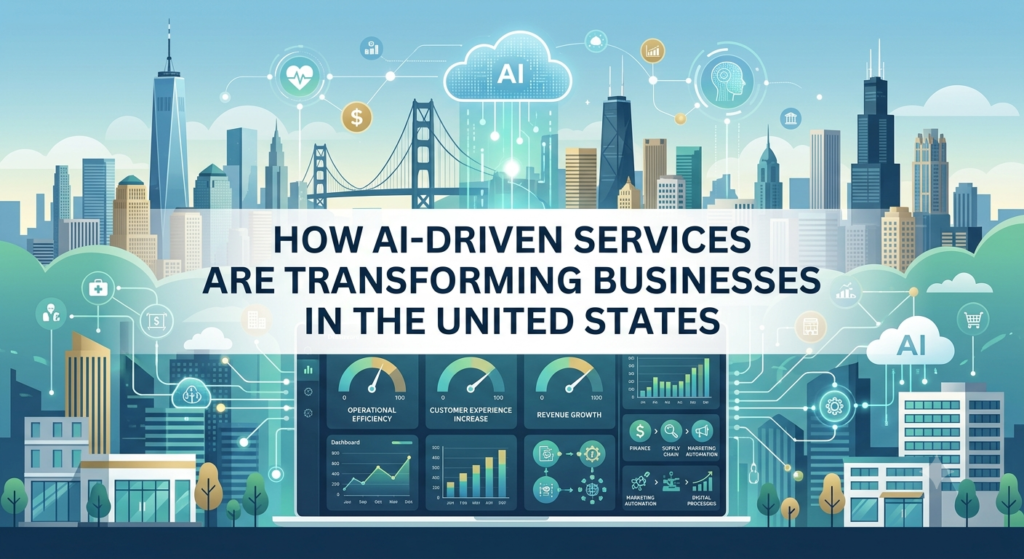
Artificial intelligence is no longer a futuristic idea reserved for huge, old organizations. Today, groups of all sizes are embracing smart solutions to decorate operations, grow productiveness, and enhance customer experiences. From small establishments to multinational agencies, corporations in some industries are adopting new tactics to leverage AI technology for growth and performance.
Understanding How AI-Driven Services Are Transforming Businesses in the United States has come to be vital for decision-makers looking for aggressive benefits in all-at-once changing markets. AI-powered solutions are allowing institutions to automate repetitive tasks, examine massive datasets, expect patron behavior, and optimize commercial enterprise techniques with unparalleled accuracy.
The United States remains one of the international community’s predominant markets for AI adoption, with companies making and funding closely studied devices, predictive analytics, intelligent automation, and AI consulting services. As the technology keeps evolving, businesses that embody innovation are positioning themselves for long-term success.
What Are AI-Driven Services and Why Are They Important for US Businesses?
AI-driven services are generative, powered by synthetic intelligence that helps corporations automate tasks, take a look at statistics, improve consumer studies, and make smarter picks.
From devices getting to know answers to predictive analytics and smart automation, the ones offering them are supporting firms across the US’s growth performance, lessening charges, and boosting digital transformation. As competition continues to increase, AI-driven offerings are becoming crucial tools for companies that want to remain innovative and competitive in the current marketplace.
- Improves Operational Efficiency: AI automates repetitive enterprise strategies and decreases the want for manual intervention. This will grow productivity and permit businesses to concentrate on strategic activities.
- Enhances Customer Experience: AI-powered chatbots and personalization equipment supply faster and more relevant assistance. Businesses can decorate purchaser delight and assist lengthy-term relationships.
- Supports Better Decision-Making: AI analyzes big datasets quickly and uncovers precious enterprise-agency insights. This lets groups make informed and fact-pushed picks, hopefully.
- Reduces Operational Costs: Intelligent automation improves workflows and minimizes expensive human mistakes. Businesses can lower expenses even while preserving performance and carrying great weight.
- Creates Competitive Advantage: AI lets corporations reply quickly to market trends and opportunities. This helps agencies stay current and outperform competition in their industry.
- Accelerates Digital Transformation: AI-driven offerings mandate the adoption of cutting-edge technology and techniques. Organizations can modernize operations and adapt quicker to changing needs.
How AI-Driven Services Are Transforming Businesses in the United States Through Automation?
One of the most significant strategies, How AI-Driven Services Are Transforming Businesses in the United States, can be determined through company automation. Organizations are using smart systems to automate repetitive obligations along with bill processing, customer onboarding, scheduling, inventory control, and data access. Automation allows employees to focus on strategic initiatives in the region instead of spending time on administrative work.
As a result, companies revel in stepped-up productivity, reduced operational costs, and higher employee satisfaction levels. AI-powered automation tools additionally perform continuously without fatigue, lowering errors and making sure of consistent overall performance. This reliability will become especially valuable for agencies coping with high transaction volumes or client interactions.
Which Business Processes Can Be Automated Using AI?
- Customer Support Operations: AI chatbots and digital assistants provide immediate responses to client inquiries, decreasing wait times and improving customer satisfaction. These systems can handle masses of conversations simultaneously while escalating complex issues to human marketers.
- Financial and Accounting Tasks: Businesses are using AI to automate invoice management, cost monitoring, fraud detection, and financial forecasting. This reduces guide attempts while improving financial accuracy and compliance.
- Human Resource Management: Recruitment agencies leverage AI tools for candidate screening, resume evaluation, and interview scheduling. These tools accelerate hiring strategies and assist businesses in discovering appropriate candidates more efficiently.
- Supply Chain Management: AI systems display inventory levels, forecast demand for styles, and optimize logistics operations. Businesses gain from reduced waste, shorter transport times, and better inventory planning.
Why Are Companies Investing Heavily in AI Business Solutions?
The developing investment in artificial intelligence is driven by measurable business results. Organizations adopting AI technology frequently experience enhancements in productivity, profitability, and customer engagement as compared to competitors relying on conventional tactics. Businesses are also coping with growing pressure to operate more effectively while demand is growing.
AI solutions help agencies respond fast to market adjustments and deliver custom-designed critiques that improve client loyalty. Additionally, declining implementation costs and the availability of cloud-based AI services have made adoption more realistic for corporations with restricted budgets and technical assets.
Key Benefits Driving AI Adoption
- Improved Efficiency: AI automates repetitive duties and decreases manual workloads across departments. This permits personnel to pay attention to strategic and higher-value activities.
- Better Decision-Making: Predictive analytics provides actionable insights from the use of real-time business data. Organizations can make quicker, smarter, and more knowledgeable decisions.
- Enhanced Customer Experience: Personalization engines deliver relevant tips and tailor-made interactions. This improves customer satisfaction, engagement, and long-term loyalty.
- Cost Optimization: Intelligent automation reduces operational costs and resource requirements. Businesses can enhance profitability while keeping the company extremely good.
- Scalability: AI systems assist growing operations without proportional staffing increases. This allows groups to grow effectively and sustainably.
- Competitive Advantage: Early adopters of AI often respond faster to market adjustments and trends. This permits corporations to innovate and outperform the competition.
How Is AI Changing Customer Service in the United States?
Customer expectations have evolved substantially in recent years, and agencies are increasing the number of uses of AI-powered customer service solutions to satisfy those needs. Consumers now expect instant responses, customized interactions, and seamless assistance options throughout multiple channels. AI chatbots, virtual assistants, and conversational AI systems allow corporations to offer 24-hour useful resources while keeping consistency in communication.
These technologies decorate reaction instances and decrease consumer frustration related to extended wait times. Machine learning systems, moreover, take a look at client behavior and alternatives to suggest merchandise, personalize advertising messages, and count on destiny’s desires. This proactive technique strengthens customer relationships and can boost retention rates.
What Technologies Are Improving Customer Experience?
-
Natural Language Processing: Natural language processing lets AI systems understand customer needs and reply in human-like conversations on websites, messaging systems, and mobile applications.
-
Recommendation Engines: Businesses use recommendation engines to suggest products and services based on browsing records, purchasing behavior, and customer opinions.
- Sentiment Analysis: AI devices study customer comments, evaluations, and social media conversations to find out satisfaction levels and areas requiring development.
How Are AI-Driven Services Transforming Businesses in the United States Through Data Analytics?
Data has emerged as one of the most precious assets for present-day organizations; however, extracting widespread insights from large volumes of data may be hard without superior technology. AI-driven offerings are reworking agencies in the United States by means of analyzing customer behavior, figuring out tendencies, forecasting demand, and assisting smarter business choices.
By turning uncooked information into actionable insights, synthetic intelligence permits companies to enhance performance, reduce dangers, and discover new growth opportunities in an increasing number of competitive markets.
- Improves Decision-Making: AI analyses massive volumes of enterprise organization information in actual time and identifies styles. This permits organizations to make faster, smarter, and more correct decisions.
- Predicts Customer Behavior: Predictive analytics identifies shopping behavior and client preferences effectively. Businesses can use those insights for higher focus and personalization techniques.
- Optimizes Marketing Campaigns: AI measures campaign performance across multiple channels and customer segments. This allows groups to improve ROI and boast purchaser engagement levels.
- Enhances Sales Forecasting: Machine learning models predict future sales and revenue opportunities successfully. Businesses can enhance planning and make more informed profit decisions.
- Identifies Business Trends: AI detects growing market trends and changing consumer behaviors early. This lets organizations respond proactively to new opportunities and worrying conditions.
- Reduces Operational Risks: Data analytics helps identify inefficiencies, fraud risks, and approach weaknesses. Businesses can take preventive measures in advance before problems impact operations significantly.
How Does Predictive Analytics Improve Business Performance?
Predictive analytics makes use of ancient statistics, synthetic intelligence, and machine-learning algorithms to find out patterns and forecast future consequences. By analyzing customer behavior, market trends, and overall operational performance, corporations can make proactive selections in the area of reacting to sports activities after they push upward. This enables corporations to beautify common overall performance, reduce risks, optimize assets, and discover new possibilities for growth in specifically competitive markets.
- Improves Demand Forecasting: Predictive models examine historical data and market trends to estimate future demand. This allows corporations to optimize inventory levels and decrease stock shortages or overstocking.
- Enhances Customer Retention: AI identifies clients who may also prevent the usage of services or products in the future. Businesses can then enforce targeted strategies to build loyalty and retention.
- Supports Better Financial Planning: Predictive analytics allows companies to forecast earnings and expenses and cash to go along with the go-with-the-flow trends. This allows for more accurate budgeting and long-term financial planning decisions.
- Reduces Equipment Downtime: Predictive maintenance systems detect potential problems in advance of machine failures. Businesses can arrange maintenance early and avoid high-priced operational disruptions.
- Optimizes Resource Allocation: AI allows corporations to distribute resources of people, inventory, and budgets more efficiently. This improves productiveness even while making sure assets are used efficiently.
- Minimises Business Risks: Predictive analytics identifies fraud patterns and operational vulnerabilities early. Businesses can take proactive moves to lessen risks and develop resilience.
Which Industries Are Benefiting Most from AI-Driven Services?
AI adoption is growing swiftly throughout a couple of industries in the United States. While tech companies were early adopters, corporations in traditional sectors are without a doubt employing AI solutions to improve performance and competitiveness. Healthcare companies use AI for diagnostics, patient tracking, and administrative automation.
Financial institutions rely on AI for fraud detection, risk evaluation, and custom-designed banking services. Retail corporations utilize predictive engines and analytics for forecasting, at the same time as manufacturing companies install predictive protection and advanced management systems to improve production efficiency.
Industries Leading AI Adoption
- Healthcare: AI facilitates clinical imaging, diagnostics, and patient management systems. Healthcare carriers use those devices to enhance accuracy and men’s and women’s health.
- Finance: Financial institutions use AI for fraud detection and credit risk assessment. It moreover lets in beautiful investment strategies and personalized banking offerings.
- Retail: Retail groups leverage AI for personalization and stock optimization. These insights help beautify consumer experiences and increase profit performance.
- Manufacturing: Manufacturers use AI for predictive safety and quality assurance processes. This reduces downtime, improves performance, and complements the extraordinary product.
- Education: AI powers adaptive learning platforms and administrative automation systems. Educational institutions use this technology to enhance learning experiences.
- Logistics: AI enables in-route optimization and smart supply chain manipulation answers. Businesses benefit from quicker deliveries and superior operational performance.
What Challenges Do Businesses Face When Implementing AI Solutions?
Despite the benefits, AI adoption offers numerous challenges that groups have to deal with carefully. Successful implementation requires strategic planning, funding, and organizational readiness. One of the most common problems entails data quality and availability.
AI models depend on accurate and whole statistics to deliver dependable insights and suggestions. Businesses must, furthermore, keep in mind employee training and exchange-managed tasks to make sure groups recognize a way to work successfully along with the AI technology.
Major AI Adoption Challenges
- Database Privacy and Security: Organizations want to have a look at guidelines while protecting sensitive statistics. Strong cybersecurity measures are critical to prevent breaches and data misuse.
- Integration with Existing Systems: Legacy infrastructure can also require enhancements to assist AI technologies successfully. Businesses often face technically worrying conditions inside the path of device integration techniques.
- Skills and Talent Shortages: Many corporations are struggling to discover professional AI professionals and data scientists. This scarcity can gradually increase implementation and boost mission charges appreciably.
- Ethical Considerations: Businesses ought to ensure transparency and equity in AI-driven choices. Responsible AI practices assist in constructing agreements and keeping regulatory compliance.
What Is the Future of AI-Driven Services in the United States?
The future of AI-pushed offerings inside the United States is anticipated to be described via using greater automation, smarter decision-making, and deeper integration across all industries. Businesses are increasingly adopting technology alongside generative AI, predictive analytics, tool analysis, and intelligent automation to enhance performance and create personalized customer experiences.
As AI generation becomes more available and low-cost, corporations of all sizes will preserve the use AI-driven services to innovate more quickly, reduce fees, and stay competitive in an unexpectedly evolving digital economy.
- Growth of Generative AI: Businesses will more and more use generative AI for content material introduction and coding obligations. It may additionally help customer support, design, and creative workflows efficiently.
- Expansion of Intelligent Automation: AI-powered automation will streamline workflows throughout multiple business enterprise features. This will lessen guide methods and enhance operational performance considerably.
- More Personalized Customer Experiences: AI will examine customer behavior and opportunities in more detail through the years. Businesses will supply more customized products, services, and recommendations.
- Stronger Predictive Analytics Capabilities: Organizations will use AI to forecast developments, risks, and consumer calls efficiently. This will help quicker and more informed strategic decision-making.
- Wider Adoption Among Small Businesses: Affordable cloud-based AI solutions will lower barriers to adoption. Small groups will benefit from getting access to superior tools previously used by businesses.
- Increased Focus on Responsible AI: Companies will prioritize transparency, ethics, and data privacy in AI deployment. Regulatory compliance and accountable practices become enterprise priorities.
Conclusion
Artificial intelligence is no longer a growing fad; it has come to be an effective driver of enterprise transformation in the United States. Understanding How AI-Driven Services Are Transforming Businesses within the United States let groups make smarter technology investments and develop strategies that help long-term growth.
From automating routine strategies to unlocking valuable insights from information, AI is assisting groups to become greater, more agile, more experienced, and more consumer-focused. AI-driven offerings are reshaping industries with the help of using improved decision-making, improving customer experiences, and creating new opportunities for innovation.
Technologies consisting of predictive analytics, intelligent automation, and generative AI are giving corporations the capability to respond fast to changing marketplace needs and gain a significant competitive advantage. Businesses that adopt those solutions nowadays are more organized to navigate the annoying situations of day-to-day.
Explore Our Recent Blogs
- Cheap vs Premium SEO Services in California
- Hiring an SEO Agency vs In-House SEO in California
- Best SEO Strategies for Lead Generation in California
- Best SEO Tools for California Businesses
- Digital Marketing Company in California
Frequently Asked Questions
- What are AI-driven services in business?
AI-driven offerings are technologies that use artificial intelligence to automate tasks, look at facts, and decorate preference-making techniques. These solutions include chatbots, predictive analytics, advice engines, and workflow automation tools. Businesses use them to improve performance and customer satisfaction.
- How are AI-driven services transforming businesses in the United States?
AI technologies are supporting agencies to automate repetitive duties, enhance customer service, and make data-driven decisions. Businesses can reduce expenses while growing productivity and operational efficiency. This transformation is occurring throughout industries, including healthcare, finance, and retail.
- Which industries benefit the most from AI adoption?
Healthcare, finance, retail, manufacturing, and logistics are some of the industries reaping advantages, notably from AI technology. These sectors use AI for predictive analytics, consumer engagement, and process optimization. Adoption keeps increasing into new markets each year.
- Is AI only suitable for large enterprises?
No, small and medium-sized groups are an increasing number of adopters of AI solutions through cloud-based systems and subscription services. Modern AI devices are smaller, less costly, and more accessible than ever before. This permits smaller companies to compete efficiently with big opposition.
- What are the biggest challenges of implementing AI?
Common disturbing situations embody amazing facts and privacy issues, integration with legacy structures, talent shortages, and regulatory compliance necessities. Businesses want to additionally cope with employee education and change management issues. Proper planning considerably improves implementation success.
- What is the future of AI-driven services in the United States?
The future includes improved adoption of generative AI, smart assistants, and independent business owner techniques. Organizations will continue making an investment in a generation that enhances productivity and innovation. AI is expected to emerge as a central player in the corporate method in the course of industries.












.png)